Thread Milling vs Tapping: How to Choose the Right Threading Method
News Details
Thread Milling vs Tapping: Which Is the Right Choice?
Tapping and thread milling are the two most common ways to cut an internal thread on a CNC machine, and they remove metal in fundamentally different ways.
Tapping uses a tap — a threaded tool with axial flutes — that enters a pre-drilled hole and cuts the full thread profile in a single pass. The tap rotates and advances at a feed rate matched to its own pitch, so every thread flank is engaged at the same time. It is a direct, one-step process: one tap for one thread size, in and out.
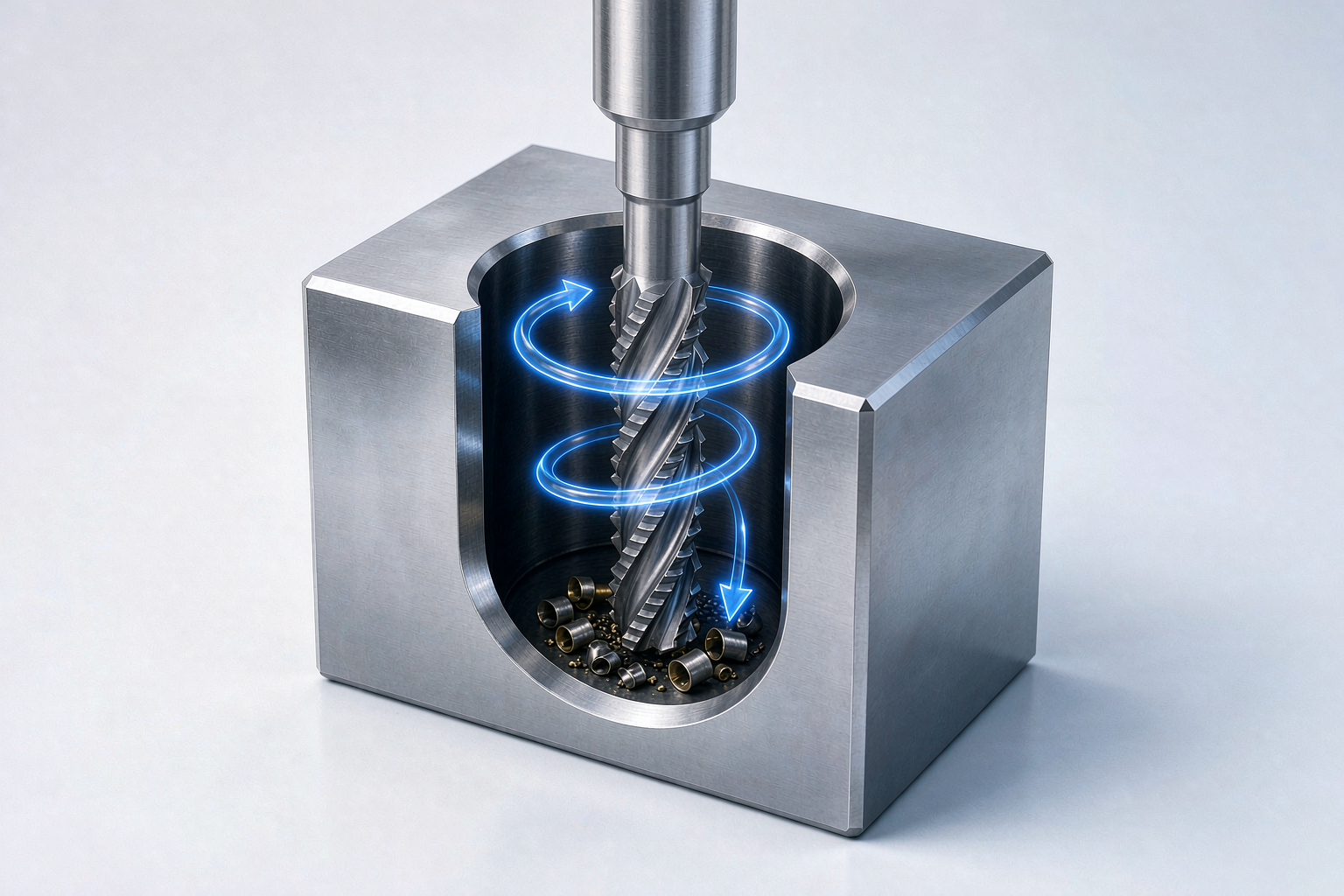
Thread milling uses a smaller-diameter cutter, typically a solid carbide thread mill, that enters the hole and travels around the inner wall along a helical interpolation path. The thread is generated progressively, one orbit at a time, with each full revolution advancing the cutter by one pitch. Because the cutter is smaller than the finished hole, there is open space around the tool for chips to escape, and the cutting load stays low throughout the pass.
The practical difference that follows from these two cutting actions shapes everything else in this article: a tap is committed to the full cut in one engagement, while a thread mill can adjust, pause or retract at any point. How much that matters depends on the part, the material and the volume.
Thread Milling vs Tapping: Side-by-Side Comparison
The table below summarizes how the two methods compare on the factors that most often decide the choice.
| Factor | Thread Milling | Tapping |
|---|---|---|
| Cycle time | Slower per hole, especially on small threads | Fast, ideal for repeated same-size holes |
| Tool breakage risk | Low — cutter can retract and the hole can be reworked | Higher — a broken tap in a finished part is costly to remove |
| Blind holes | Excellent — threads can reach close to the bottom | Limited by tap lead, chip packing and relief space |
| Hard materials | Progressive cutting keeps loads low in hard or tough alloys | Challenging; needs specialized taps and careful conditions |
| Thread size flexibility | One cutter can cover multiple diameters of the same pitch | One tap per size and pitch |
| Thread quality | Good surface finish; pitch diameter adjustable in program | Good when conditions are right, but size depends on the tap |
| Large-diameter threads | Cost-effective; cutting forces stay moderate | Large taps become expensive and demanding |
| Setup and programming | Needs helical interpolation and a proven program | Simple; works with standard tapping cycles |
No single row wins the comparison on its own. The right question is which of these factors dominates in your application.
When to Use Thread Milling
Thread milling earns its place in four situations that appear again and again in precision machining.
Blind holes with deep thread engagement
In a blind hole, a tap needs lead room for its chamfered end, space for chips and clearance before it bottoms out — which often means the usable thread stops short of where the design wants it. A thread mill cuts with the end and side of the tool along a controlled path, so the thread can extend much closer to the bottom of the hole, and chips are not forced ahead of a full-profile tool.
Difficult-to-machine materials
In stainless steels, titanium alloys and other hard or work-hardening materials, the full-profile engagement of a tap generates high torque and heat in one pass — the classic setup for a broken tap. Thread milling distributes the cut over several light orbits, keeping cutting forces and heat lower. In expensive workpieces, avoiding one scrapped part can justify the longer cycle time many times over.
Multiple thread sizes with shared characteristics
A single thread mill can often cover several diameters of the same pitch, simply by changing the programmed orbit. For shops that handle mixed work, this replaces drawers of taps with one or two cutters and a library of programs — fewer tool changes, less inventory and faster changeovers.
High-value or hard-to-rework parts
Where a scrapped part means hours of lost machining — aerospace components, medical parts, large housings — process security matters more than raw speed. Thread milling offers a recovery path that tapping does not: if the size is off, the operator adjusts an offset and recuts the thread in place.
Thread Milling Advantages and Disadvantages
The advantages of thread milling follow directly from its progressive cutting action:
- Low breakage risk and in-machine rework — size adjustments are made in the program, without crossed threads
- One cutter for multiple diameters of the same pitch, reducing tool inventory
- Threads close to the bottom of blind holes without special tap geometries
- Lower, more stable cutting loads in difficult materials
- Better surface finish, because the thread is milled rather than formed in one heavy pass
- Ability to cut both internal and external threads with suitable tooling
The disadvantages are just as real and should be weighed honestly:
- Slower cycle time than tapping, especially on small, repeated holes
- More demanding programming — the machine must support helical interpolation on all three axes
- Higher purchase price per tool than a standard tap
- Very small thread mills are delicate; for tiny diameters in forgiving materials, a tap may remain the practical choice
- Results depend on setup rigidity — a poor setup erodes the quality advantage
When Tapping Is Still the Right Choice
None of this makes tapping obsolete. For high-volume production of standard threads in free-cutting materials, tapping remains the fastest and most economical route. An M8 through hole in mild steel, repeated thousands of times on a well-maintained machine, is exactly the job a tap is built for: one tool, one motion, minimal programming effort.
Tapping also makes sense when the machine cannot perform reliable helical interpolation, when the shop runs simple tapping cycles on older equipment, or when thread tolerance is not critical and tool budget is tight. A balanced threading strategy uses both methods: taps for the fast, repeatable work, and thread mills where flexibility, material difficulty or scrap risk justify the extra cycle time.
Thread Milling vs Tapping Cost: Beyond the Tool Price
Comparing the price tags of a tap and a thread mill is the easiest comparison to make and the most misleading. A tap costs less, and per hole in easy materials it usually produces the cheaper thread. The total cost picture adds several factors:
- Scrap exposure. When a tap breaks in a nearly finished workpiece, the loss is the value of everything already done to that part — not the price of the tap. On high-value parts, a single avoided breakage can offset the price difference for an entire tool kit.
- Inventory. One thread mill covering several diameters replaces a set of taps, reducing stock, tool changes and the risk of reaching for a worn or wrong-size tap.
- Rework and downtime. A thread milled slightly out of tolerance is corrected at the machine with an offset change. An oversize or undersize tapped hole usually means hand rework off the machine — or scrap.
- Tool consumption. Taps wear with every hole in abrasive or hard materials; a carbide thread mill spreads wear over more metal removed per edge, which can favor milling on longer runs in tough alloys.
For low-to-medium volume work with varied thread sizes, difficult materials or expensive parts, the total cost frequently favors thread milling. For long runs of identical, standard threads in easy materials, tapping usually keeps the lowest cost per hole.
Choosing the Right Carbide Thread Mill
Once the application calls for thread milling, tool selection determines whether the process delivers its potential. The key checks before ordering:
- Material match. Fine-grain solid carbide with a coating suited to the workpiece material — the same principle that applies across end mills and drills — keeps edge wear predictable in stainless, titanium and hardened steels.
- Pitch range and thread form. Confirm the cutter's permitted pitch range and thread standard for every size it will be asked to produce. Sharing a nominal diameter does not make two pitches interchangeable.
- Reach and neck clearance. Deep or blind holes need adequate flute length and neck clearance so the thread can be cut to depth without the shank or holder interfering.
- Minimum bore. The cutter and its neck must physically fit the smallest hole on the job list.
- Machine capability. Reliable helical interpolation and adequate rigidity are prerequisites; verify the program and the setup before committing production.
Working with a manufacturer that produces solid carbide threading tools in-house shortens this loop. Qinrui Precision Tools (Changzhou Qinrui Precision Tools Co., Ltd.), a solid carbide cutting tool manufacturer based in Changzhou, China, produces end mills, drills, reamers, thread mills and custom non-standard formed tools for automotive, aerospace and machinery automation applications, and can supply thread mills matched to specific materials and thread standards — including formed tools where a catalog size does not fit.
FAQ
Can a thread mill replace a tap in an existing process?
Technically yes in most CNC applications, but the better question is whether it adds value. If current tapping is stable, fast and trouble-free, keep it. Move to thread milling when size control, breakage risk, thread depth or material difficulty is costing real time or money.
Do thread mills need a pre-drilled hole?
Standard thread milling cuts into an existing hole, so the hole is drilled first. Some specialized tools can drill, thread and chamfer in one setup, but for most jobs a correctly sized pre-hole remains part of the process.
Is thread milling practical for small threads?
It can be, with care: very small thread mills are more delicate and less forgiving of runout. For tiny diameters in easy materials, tapping often remains the more robust choice.
Which method produces a better thread?
Thread milling generally produces a cleaner finish and offers direct control of pitch diameter through offset adjustment. A sharp, well-applied tap in suitable material also produces sound threads — the difference is that milling quality can be corrected at the machine, while tapping quality depends on conditions set before the first revolution.


