Carbide Drill Bits: Types, Selection, Coatings and Troubleshooting for Metal Drilling
News Details
Carbide drill bits have become the default hole-making tool in most modern metalworking shops, but the term itself covers a family of tools built for very different jobs. Two drills that both carry the carbide label can differ in substrate, coating, coolant design and point geometry — and those differences decide whether a hole is produced in seconds or ruined in one pass. This guide explains what carbide drill bits are, how they compare with high-speed steel, how to select one for steel and stainless steel, which coating suits which material, when through-coolant designs are worth the extra cost, and what to check when a hole goes wrong.
What carbide drill bits are and where they fit
Solid carbide drill bits are machined from tungsten carbide with a cobalt binder. The material is far harder and much more heat resistant than high-speed steel: published tooling comparisons commonly cite hardness around 89–93 HRA for carbide against roughly 62–67 HRC for HSS, with heat resistance in the region of 1,200 °C versus about 600 °C. That combination allows carbide tools to run at cutting speeds several times higher than HSS in steel, commonly quoted at 80–200 m/min for carbide against 25–40 m/min for HSS.
The trade-off is brittleness. Carbide tolerates heat and abrasion but not shock, vibration or misalignment. A carbide drill rewarded with a rigid machine, a stable holder and low runout will hold tolerance over long runs; the same drill in a hand-held tool or a worn spindle may chip on the first hole. Published comparisons put carbide tool life at roughly 10–20 times HSS in steel, with a unit price three to five times higher — which is why the decision is usually made on cost per hole and downtime rather than on the price of a single drill.
Types of carbide drill bits
Most catalogues group carbide drills by construction and by the hole problem they solve.
- Solid carbide twist drills are the general-purpose workhorse for steel, cast iron, aluminium and non-ferrous work. Straight-shank, rigid and available in stub, jobber and long series.
- Through-coolant drills carry internal channels that deliver coolant to the cutting edge. They are the standard choice for deep holes and for materials that produce long, stringy chips.
- Carbide-tipped drills braze a carbide insert onto a steel body. They suit abrasive work such as masonry, some cast irons and large-diameter holes where a full carbide body would be uneconomic.
- Micro drills are solid carbide tools for small holes in electronics, medical parts and precision instrument work, where high spindle speed and minimal runout matter more than feed rate.
- Step drills cut several diameters in one tool, reducing tool changes on sheet metal and thin-walled parts.
- High-performance drills combine application-specific flute geometry, edge preparation and coating for stainless steel, titanium, hardened steel and superalloys.
The practical rule is that construction should follow the hole, not the catalogue page: diameter, depth, tolerance, material and machine rigidity together point to one family.
Carbide vs HSS drill bits
The comparison below reflects values that appear in published tooling references. They are typical ranges for orientation, not guarantees for a specific drill or machine, because results depend heavily on the workpiece, the holder and the cutting data.
| Property | Solid carbide drill | HSS drill |
|---|---|---|
| Hardness | About 89–93 HRA | About 62–67 HRC |
| Heat resistance | Up to roughly 1,200 °C | Up to roughly 600 °C |
| Cutting speed in steel | Commonly 80–200 m/min | Commonly 25–40 m/min |
| Toughness | Low; sensitive to shock and misalignment | High; forgiving in unstable setups |
| Tool life in steel | Reported at roughly 10–20 times HSS | Baseline |
| Relative tool cost | About 3–5 times higher | Lowest |
| Typical fit | CNC production, tight tolerance, hard or abrasive material | Manual drilling, maintenance, low volume, poor rigidity |
In practice, carbide wins when the machine is rigid, the tolerance matters, the material is hard or abrasive, and tool changes cost more than the price difference. HSS or cobalt HSS still makes sense for one-off work, hand drilling, repair jobs and older machines with runout that would chip a carbide edge.
How to choose a drill bit for steel
Steel is not one material. Mild steel, alloy steel, stainless steel and hardened steel behave differently, so selection should follow a fixed order rather than a favourite drill.
- Identify the material group. Tooling references use ISO groups — P for steels, M for stainless, K for cast iron, N for non-ferrous, S for superalloys and H for hardened materials. The group drives edge preparation, coating and cutting data.
- Pick the drill construction. Solid carbide for speed, accuracy and life in stable setups; through-coolant carbide for depth and chip evacuation; cobalt HSS where rigidity is limited or volume is low.
- Match the point geometry. A 135° split point self-centres, reduces thrust and stops the drill walking on alloy and stainless steel. A 118° point is more versatile but often needs a pilot hole in hard metals.
- Check flute length against hole depth. Flutes should be longer than the hole plus the material thickness so chips can escape; a short-flute drill in a deep hole packs debris and overheats.
- Decide on coolant. Internal coolant is close to mandatory beyond about 5×D and becomes non-negotiable at 8×D and deeper.
- Choose the coating for the material, not for the colour on the box.
- Confirm rigidity and runout — holder, fixture and spindle condition decide whether carbide can be used at all.
- Start from the maker's cutting data and tune from chips and load rather than from guesswork.
Beyond about 12–13 mm diameter in hard steel, a twist drill starts to struggle; annular cutters or indexable insert drills usually become the better answer, and the same logic applies when the hole is large relative to the machine.
Drill bit coating: TiAlN vs TiN
Coatings are heat management. They do not cut, but they limit how much heat reaches the carbide substrate and how much wear the flank sees. Published comparison tables commonly cite the following values.
| Coating | Hardness | Working temperature | Typical use | Watch out for |
|---|---|---|---|---|
| TiN | About 2,200–2,500 HV | Around 600 °C | Carbon steel, cast iron, general work | Oxidises quickly at high speed and temperature |
| TiAlN | About 2,800–3,200 HV | Around 900–1,000 °C | Stainless steel, alloy steel, titanium, high-speed and dry cutting | Built-up edge risk in aluminium |
| AlTiN | About 3,000–3,500 HV | Around 1,000–1,100 °C | Hardened steel, superalloys | More brittle; poor fit for interrupted cuts |
| DLC | About 5,000–8,000 HV | Around 400–500 °C | Aluminium, copper alloys, composites | Degrades if the cutting zone runs very hot |
The usual mistake is treating TiAlN as an upgrade for everything. In ferrous work it is, because the aluminium in the coating forms a thin oxide layer that resists heat. In aluminium and other soft non-ferrous alloys it can work against you: the coating promotes chip welding and built-up edge, so polished flutes, ZrN-type finishes or DLC are the better choice. TiN remains a sensible, lower-cost option for carbon steel and cast iron where cutting temperatures stay moderate.
Through coolant drill bits for deep holes
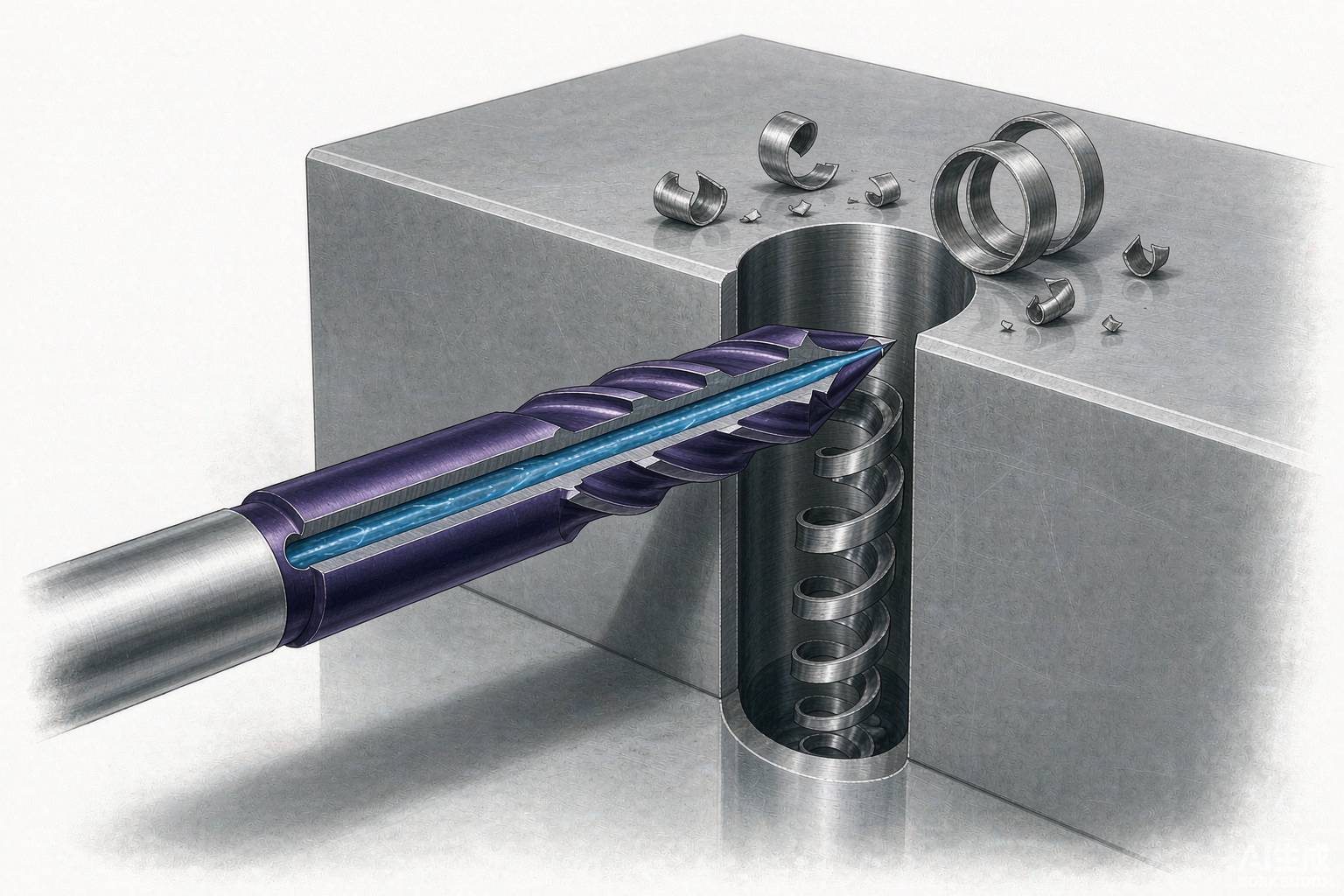
Chip evacuation is the real limit on hole depth. Once chips start to pack in the flutes, torque climbs, heat concentrates and the drill either breaks or leaves a torn hole. Through-coolant drills solve this by delivering coolant through internal channels directly to the cutting edge, so chips are pushed back out of the hole instead of being re-cut.
In published tooling guidance, deep-hole carbide families are offered in 8×D, 12×D and even 20×D length-to-diameter ratios. These are not interchangeable with standard-length drills: they require sufficient coolant pressure and flow, correct depth-ratio selection, and a rigid setup. Where coolant pressure is inadequate, peck drilling with a standard drill is often more reliable than a through-coolant drill running under-flushed.
Drilling stainless steel with carbide drills
Stainless steel punishes the wrong drill more than mild steel does. Austenitic grades work-harden quickly, and a drill that rubs instead of cutting will harden the surface it is trying to enter. Long, stringy chips then wrap the tool, trap heat and break edges.
Carbide drills for stainless steel are usually paired with through-coolant designs and a sharper, positive edge preparation than general-purpose drills. The priorities are continuous feed rather than dwelling, enough coolant to clear chips and cool the edge, and cutting data that keeps the tool working under the hardened layer. Cobalt HSS remains a reasonable alternative for low-volume or manual work in stainless, where its toughness matters more than speed.
Drill bit point angle and geometry
Point angle and flute design decide how the drill enters and how the chip leaves.
- 118° is the traditional general-purpose point. It is versatile and forgiving, but in hard metals it often needs a pilot hole or a centre drill to start accurately.
- 135° split point self-centres, lowers thrust and reduces walking. It is the common choice for alloy steel, stainless and CNC work where position accuracy matters.
- 140° and flatter points appear on some high-performance and hardened-material drills, trading entry ease for edge strength.
- Web thickness and helix angle control chip room and rigidity. Tough materials favour stronger cores; long-chipping grades need flute geometry that moves chips away quickly.
Geometry is also where regrinding matters: a drill resharpened to a different point angle no longer matches the cutting data it was bought with, and performance drops before anything visibly breaks.
Common drilling problems and solutions
| Symptom | Likely cause | First action |
|---|---|---|
| Chips clog the flutes | Insufficient coolant flow or pressure, flute too short for the depth, feed too high for the chip form | Raise coolant flow and pressure, reduce feed slightly, use pecking or a through-coolant drill |
| Edge chipping or breakage | Runout, unstable clamping, feed too aggressive on entry, drill too long for the diameter | Check holder and alignment, shorten overhang, reduce feed at entry, verify cutting data |
| Oversize or out-of-round holes | Worn or wrongly ground point, vibration, poor centring | Inspect point geometry, improve rigidity, use a split-point drill or pilot hole |
| Rough hole wall or torn exit | Built-up edge, insufficient coolant, feed too low causing rubbing | Match coating to material, increase coolant, raise feed into the cut |
| Colour changes on the drill edge | Cutting temperature too high; coating locally failed | Reduce speed, improve cooling, replace the drill before the substrate is affected |
Cost per hole puts these symptoms in perspective. A drill that lasts longer but breaks unpredictably is usually more expensive than a cheaper one retired on schedule, because scrap, rework and unplanned downtime cost more than the tool. Tracking tool life, regrinds and stoppages per part is the only reliable way to compare two drills on the same job.
Frequently asked questions
Are carbide drill bits worth it for a small workshop?
It depends on the machine rather than the workshop size. If the spindle is rigid, the holder is in good condition and holes are drilled in production or in hard material, a carbide drill usually lowers cost per hole. For occasional hand drilling or unstable setups, the risk of chipping outweighs the speed advantage.
Can carbide drills be used without coolant?
Some coated grades are designed for dry or minimum-quantity lubrication in specific materials, but most carbide drilling relies on coolant for heat control and chip evacuation. Cutting dry with a general-purpose carbide drill in steel usually shortens tool life sharply.
Which coating should be used for aluminium?
Polished flutes, ZrN-type finishes or DLC are the usual choices. TiAlN is generally avoided because it encourages built-up edge on aluminium, which leads to poor hole finish and unstable dimensions.
What this means for buyers
Selection comes down to four questions: what material, how deep, how tight, and how rigid is the machine. Answer those and the drill family, coating and coolant design follow. Drills bought on price alone tend to be re-bought often; drills matched to the process tend to be bought once and reground.


