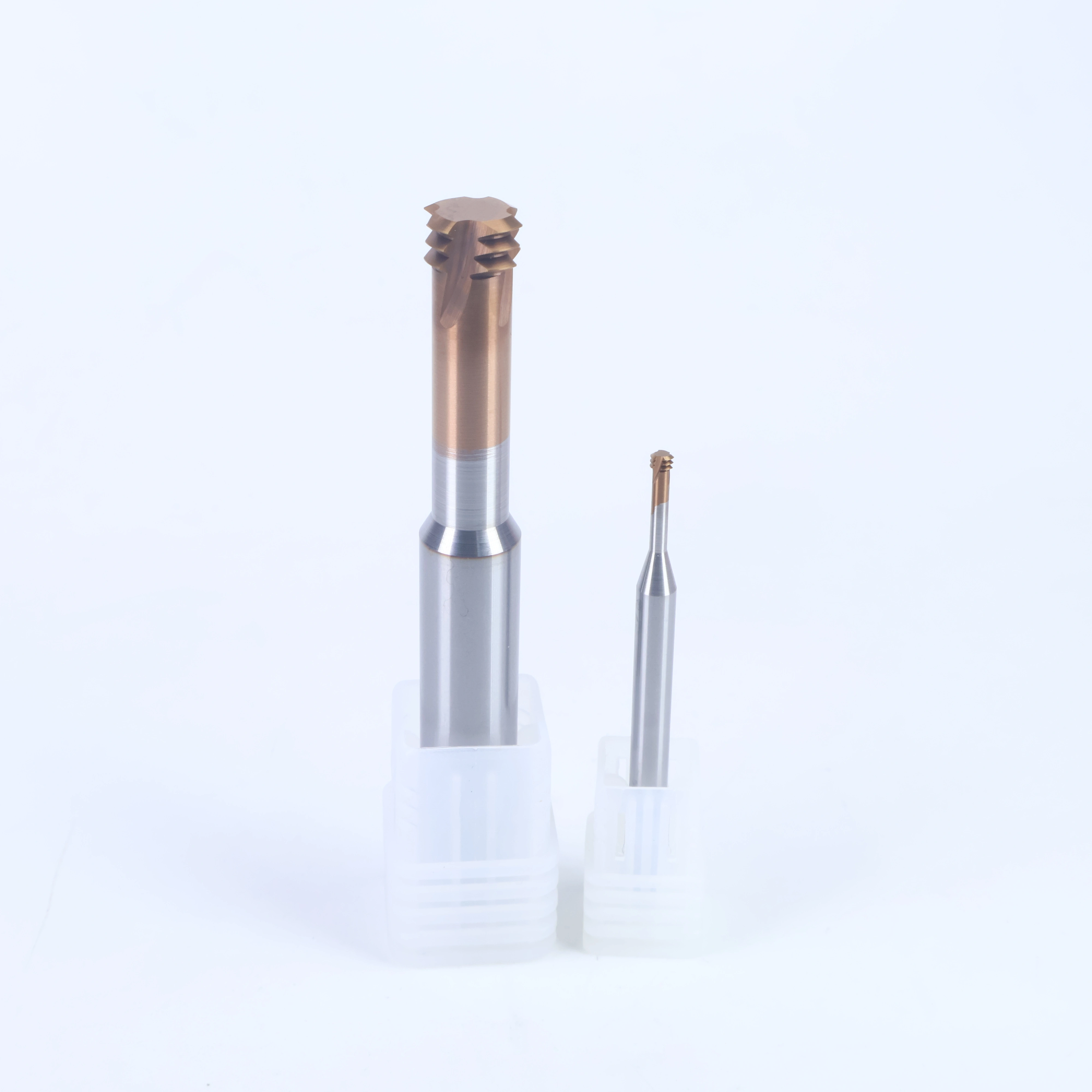
The three-tooth thread milling cutter is a solid carbide thread mill that carries three thread-form cutting teeth in a row, all ground to the 60° ISO metric profile. It fills the gap between two familiar tool styles. A single-tooth thread mill has one cutting section, so it follows any thread depth and any pitch the machine can interpolate, but every thread costs a full series of passes. A full-profile thread mill carries the complete crest-to-root form and finishes the thread in about one revolution, but one tool serves one pitch. Three teeth in a row take a middle position: the depth of cut is shared by three teeth instead of one, the feed per revolution rises with the number of teeth at the same chip load per tooth, and the finished thread diameter can still be trimmed through the interpolation radius.
In the cut, the tool is fed into the prepared bore on a helical path whose lead equals the thread pitch, and the three teeth engage the flank at the same time, one pitch apart. Because the load is spread over three cutting edges, the cutter runs with a lighter chip per tooth than a single-tooth tool at the same feed, which keeps heat and edge wear down and gives a more even thread flank on steel. The trade-off is reach and clearance: the cutting section is longer than a single-tooth section, so a blind hole needs enough clearance below the thread for the full tooth row plus the tool nose, and deep bores need the longer shank versions listed further down this page. Cutting diameter, flute length and shank diameter are given for every size, and the pilot hole diameter in the last column is the bore to drill or mill before the thread is interpolated.
Three-tooth geometry pays off in three situations. The first is a family of parts that share one pitch but not one nominal diameter: because the finished diameter comes from the interpolation radius, a single cutter covers the diameters that share its pitch, so an M8x1.25 tool also threads M10x1.25 and M12x1.25 bores in the same set-up. The second is the small end of the metric range, M1.6 to M5, where a tap is fragile and a single-tooth mill is slow; here the compact series with a 6 mm shank keeps the tool stiff enough to hold thread form at small cutting diameters. The third is deep or recessed work, where the 75L series puts the cutting section far enough from the holder to reach into cavities that a standard 50 mm tool cannot enter.
The standard range below runs from M1.0 to M30 with pitches from 0.25 mm to 3.5 mm, in overall lengths of 50, 60, 75 and 90 mm as the thread size grows. Two further series follow it: a compact 6 mm shank series for small threads, and the 75L extended series for deep holes. The whole range is ground in solid carbide in the steel grade, for carbon steel, alloy steel, stainless steel and cast iron workpieces; other grades and coatings are ground to order.
Metric Three-Tooth Range
The table lists the standard metric three-tooth range. Pitch is given first, then the metric thread designation at that pitch. Cutting diameter is the maximum diameter of the thread form, flute length is the usable cutting length, and cutting edges gives the number of flutes, which is three on the smaller sizes and four from M12 upward. Pilot hole diameter follows the usual rule of nominal diameter minus pitch, with a small allowance for drilling.
| Pitch |
Thread size |
Cutting dia. |
Flute length |
Shank dia. |
Overall length |
Cutting edges |
Pilot hole dia. |
| (mm) |
Designation |
d (mm) |
(mm) |
D (mm) |
(mm) |
Teeth |
(mm) |
| 0.25 |
M1.0x0.25 |
0.73 |
2.3 |
4 |
50 |
3 |
0.75 |
| 0.25 |
M1.2x0.25 |
0.92 |
2.8 |
4 |
50 |
3 |
0.95 |
| 0.3 |
M1.4x0.3 |
1.05 |
3.2 |
4 |
50 |
3 |
1.05 |
| 0.35 |
M1.6x0.35 |
1.2 |
3.3 |
4 |
50 |
3 |
1.25 |
| 0.35 |
M1.8x0.35 |
1.41 |
4.1 |
4 |
50 |
3 |
1.45 |
| 0.4 |
M2.0x0.4 |
1.54 |
4.4 |
4 |
50 |
3 |
1.6 |
| 0.45 |
M2.2x0.45 |
1.63 |
4.8 |
4 |
50 |
3 |
1.75 |
| 0.45 |
M2.5x0.45 |
1.96 |
5.3 |
4 |
50 |
3 |
2.05 |
| 0.5 |
M3x0.5 |
2.4 |
6.4 |
4 |
50 |
3 |
2.5 |
| 0.5 |
M4x0.5 |
3 |
8.6 |
4 |
50 |
3 |
3.5 |
| 0.5 |
M8x0.5 |
6 |
17.3 |
6 |
50 |
3 |
7.5 |
| 0.5 |
M10x0.5 |
8 |
21.8 |
8 |
60 |
3 |
9.5 |
| 0.6 |
M3.5x0.6 |
2.75 |
7.4 |
4 |
50 |
3 |
2.9 |
| 0.7 |
M4x0.7 |
3.15 |
8.6 |
4 |
50 |
3 |
3.3 |
| 0.75 |
M4.5x0.75 |
3.5 |
9.5 |
4 |
50 |
3 |
3.8 |
| 0.75 |
M6x0.75 |
4.8 |
13 |
6 |
50 |
3 |
5.3 |
| 0.75 |
M8x0.75 |
6 |
17.3 |
6 |
50 |
3 |
7.3 |
| 0.75 |
M10x0.75 |
8 |
21.8 |
8 |
60 |
3 |
9.3 |
| 0.8 |
M5x0.8 |
4 |
12 |
4 |
50 |
3 |
4.2 |
| 1.0 |
M6x1.0 |
4.75 |
13 |
6 |
50 |
3 |
5 |
| 1.0 |
M8x1.0 |
6 |
17.3 |
6 |
50 |
3 |
7 |
| 1.0 |
M10x1.0 |
8 |
21.8 |
8 |
60 |
3 |
9 |
| 1.0 |
M12x1.0 |
10 |
25 |
10 |
75 |
4 |
11 |
| 1.0 |
M14x1.0 |
10 |
28 |
10 |
75 |
4 |
13 |
| 1.0 |
M16x1.0 |
12 |
30 |
12 |
75 |
4 |
15 |
| 1.0 |
M20x1.0 |
15.8 |
40 |
16 |
90 |
4 |
19 |
| 1.25 |
M8x1.25 |
6 |
17.3 |
6 |
50 |
3 |
6.8 |
| 1.25 |
M10x1.25 |
8 |
21.8 |
8 |
60 |
3 |
8.8 |
| 1.25 |
M12x1.25 |
10 |
25 |
10 |
75 |
4 |
10.8 |
| 1.25 |
M14x1.25 |
10 |
28 |
10 |
75 |
4 |
12.8 |
| 1.25 |
M16x1.25 |
12 |
30 |
12 |
75 |
4 |
14.8 |
| 1.5 |
M10x1.5 |
8 |
21.8 |
8 |
60 |
3 |
8.6 |
| 1.5 |
M12x1.5 |
10 |
25 |
10 |
75 |
4 |
10.6 |
| 1.5 |
M14x1.5 |
10 |
28 |
10 |
75 |
4 |
12.6 |
| 1.5 |
M16x1.5 |
12 |
30 |
12 |
75 |
4 |
14.6 |
| 1.5 |
M20x1.5 |
15.8 |
40 |
16 |
90 |
4 |
18.6 |
| 1.75 |
M12x1.75 |
10 |
24 |
10 |
75 |
4 |
10.3 |
| 2.0 |
M14x2.0 |
10 |
25 |
10 |
75 |
4 |
12.1 |
| 2.0 |
M16x2.0 |
11.5 |
27 |
12 |
75 |
4 |
14.1 |
| 2.0 |
M20x2.0 |
15.8 |
40 |
16 |
90 |
4 |
18.1 |
| 2.5 |
M20x2.5 |
15 |
36 |
16 |
90 |
4 |
17.6 |
| 3.0 |
M24x3.0 |
16 |
45 |
16 |
90 |
4 |
21.2 |
| 3.5 |
M30x3.5 |
16 |
48 |
16 |
90 |
4 |
26.5 |
6 mm Shank Compact Range
The compact series uses a 6 mm shank on every size, from M1.6 to M5, with a 50 mm overall length. The heavier shank is what makes the small cutting diameters practical: at M1.6x0.35 the thread form is only 1.2 mm across, and the extra shank stiffness is what keeps the tooth row from springing in the cut.
| Pitch |
Thread size |
Cutting dia. |
Flute length |
Shank dia. |
Overall length |
Cutting edges |
Pilot hole dia. |
| (mm) |
Designation |
d (mm) |
(mm) |
D (mm) |
(mm) |
Teeth |
(mm) |
| 0.35 |
M1.6x0.35 |
1.2 |
3.3 |
6 |
50 |
3 |
1.25 |
| 0.4 |
M2.0x0.4 |
1.54 |
4.4 |
6 |
50 |
3 |
1.6 |
| 0.45 |
M2.5x0.45 |
1.96 |
5.3 |
6 |
50 |
3 |
2.05 |
| 0.5 |
M3x0.5 |
2.4 |
6.4 |
6 |
50 |
3 |
2.5 |
| 0.7 |
M4x0.7 |
3.15 |
8.6 |
6 |
50 |
3 |
3.3 |
| 0.8 |
M5x0.8 |
4 |
12 |
6 |
50 |
3 |
4.2 |
75L Extended Range
The 75L extended series keeps the same three-tooth geometry but lengthens the tool to 75 mm overall, which is 25 mm more reach than the standard small-size tools. Shank diameter steps from 4 mm at the smallest sizes to 8 mm at M10x1.5, and flute length runs from 6.4 mm to 35 mm, so the series covers threads at the bottom of deep cavities, in mould pockets and in parts where the holder would otherwise foul the workpiece.
| Pitch |
Thread size |
Cutting dia. |
Flute length |
Shank dia. |
Overall length |
Cutting edges |
Pilot hole dia. |
| (mm) |
Designation |
d (mm) |
(mm) |
D (mm) |
(mm) |
Teeth |
(mm) |
| 0.35 |
M1.6x0.35 |
1.2 |
6.4 |
4 |
75 |
3 |
1.25 |
| 0.4 |
M2.0x0.4 |
1.54 |
8 |
4 |
75 |
3 |
1.6 |
| 0.45 |
M2.5x0.45 |
1.96 |
10 |
4 |
75 |
3 |
2.05 |
| 0.5 |
M3x0.5 |
2.4 |
12 |
4 |
75 |
3 |
2.5 |
| 0.7 |
M4x0.7 |
3.15 |
16 |
4 |
75 |
3 |
3.3 |
| 0.8 |
M5x0.8 |
4 |
20 |
6 |
75 |
3 |
4.2 |
| 1.0 |
M6x1.0 |
4.75 |
24 |
6 |
75 |
3 |
5 |
| 1.25 |
M8x1.25 |
6 |
32 |
6 |
75 |
3 |
6.75 |
| 1.5 |
M10x1.5 |
8 |
35 |
8 |
75 |
3 |
8.5 |